Common Houseplant Pests: How to Identify and Treat Them
Spider mites, mealybugs, fungus gnats, and scale each need a different treatment. Learn to identify what's attacking your plant and how to get rid of it.
Published · Updated · 8 min read
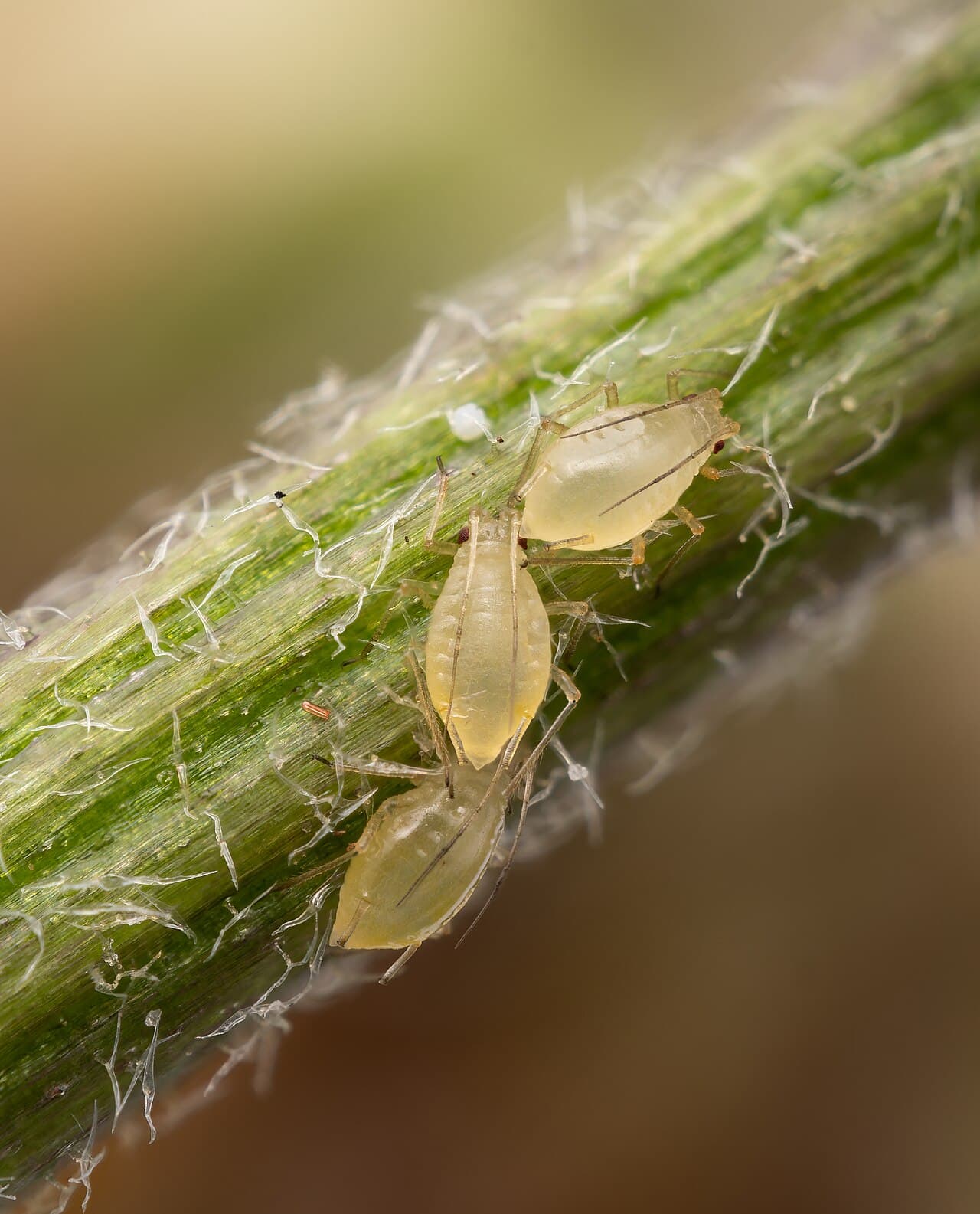
Photo: Green peach aphid (Myzus persicae) on a stem by Jules Verne Times Two (CC BY-SA 4.0)
Spider mites
Look for fine, silky webbing between leaves and stems, along with tiny yellow or white speckling on the leaf surface. Spider mites thrive in dry indoor air, so raising humidity around the plant helps prevent them. Treat with insecticidal soap or neem oil, spraying thoroughly on the undersides of leaves where mites cluster, and repeat weekly for three to four weeks to catch newly hatched mites.
Mealybugs
These appear as small, cottony white clusters, usually tucked into leaf joints and along stems. Dab visible clusters with a cotton swab dipped in rubbing alcohol, then follow up with a full-plant application of insecticidal soap, since mealybugs hide in crevices a cotton swab alone will miss.
Fungus gnats
Small, dark flies hovering around the soil surface are almost always fungus gnats, whose larvae feed on organic matter in consistently damp soil. Letting the top inch or two of soil dry out fully between waterings breaks their breeding cycle, and yellow sticky traps placed near the soil catch the adults.
Scale
Scale insects look like small, immobile brown or tan bumps stuck to stems and leaf undersides, and are easy to mistake for a plant deformity rather than a pest. Their waxy shell resists sprays, so scrape visible scale off with a fingernail or soft brush, then treat with neem oil or insecticidal soap to catch the mobile juvenile stage.
Aphids
Small, soft-bodied insects, often green or black, cluster on new growth and flower buds. A strong spray of water knocks most aphids off, and insecticidal soap applied every few days for two weeks handles the rest.
General prevention
Quarantine new plants away from your existing collection for one to two weeks before introducing them, since most infestations start with a single new arrival. Inspect leaf undersides and stem joints regularly — catching a pest problem early, before it spreads to nearby plants, is far easier than treating an established infestation.